

Charles Chesnutt The Goophered Grapevine
| Charles Westward. Chesnutt | |
|---|---|
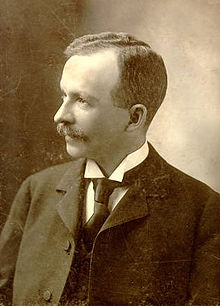 Chesnutt at age forty | |
| Born | June xx, 1858 Cleveland, Ohio |
| Died | November 15, 1932 (aged 74) Cleveland, Ohio |
| Resting place | Lake View Cemetery |
| Occupation | Author, political activist, lawyer |
| Spouse | Susan Perry |
| Children | 4 |
Charles Waddell Chesnutt (June 20, 1858 – November 15, 1932) was an American writer, essayist, political activist and lawyer, all-time known for his novels and short stories exploring complex issues of racial and social identity in the post-Civil War Due south. Two of his books were adjusted as silent films in 1926 and 1927 by the African-American managing director and producer Oscar Micheaux. Following the Civil Rights Motility during the 20th century, interest in the works of Chesnutt was revived. Several of his books were published in new editions, and he received formal recognition. A commemorative stamp was printed in 2008.
During the early 20th century in Cleveland, Chesnutt established what became a highly successful court reporting business, which provided his main income. He became active in the National Association for the Advancement of Colored People, writing articles supporting pedagogy as well as legal challenges to discriminatory laws.
Early life [edit]
Chesnutt was born in Cleveland, Ohio, to Andrew Chesnutt and Ann Maria (née Sampson) Chesnutt, both "costless persons of color" from Fayetteville, North Carolina.[i] His paternal grandfather was known to be a white slaveholder. He identified every bit African American just noted that he was seven-eighths white.[two] Given his bulk-European ancestry, Chesnutt could "pass" as a white man, but he never chose to do then. In many southern states at the time of his birth, Chesnutt would have been considered legally white if he had chosen to identify and then. Past contrast, under the one drop rule later adopted into police force by the 1920s in nigh of the Southward,[Notes 1] he would have been classified equally legally black because of some known African beginnings.
Afterwards the end of the Ceremonious War and resulting emancipation, in 1867 the Chesnutt family unit returned to Fayetteville; Charles was 9 years old.[1] His parents ran a grocery store, but it failed because of his father's poor business practices and the struggling economy of the postwar South.[1] By the historic period of 14, Chesnutt was a pupil-teacher at the Howard School, i of many founded for blackness students by the Freedmen'south Agency during the Reconstruction era.[1]
Education career [edit]
Chesnutt continued to study and teach. He somewhen was promoted to banana principal of the normal school in Fayetteville, one of a number of historically black colleges established for the grooming of Black teachers. The normal school developed into Fayetteville State University. Freedmen fabricated instruction a priority during the 19th century. Every bit the historian David Blight remarked in an interview, formerly enslaved individuals "embraced didactics like nix else. They lined up in droves, old and immature, to go to night schoolhouse, to go to morn school."[iii] Reconstruction legislatures had created the first systems of public instruction in the states of the S, simply they made them segregated every bit part of the price of passage. Many Black people, both from the North and the Due south, "entered freed-people's classrooms out of a sense of racial commitment that sometimes reached across lines of course and color."[4]
Marriage and family [edit]
In 1878 at the age of 20, Chesnutt married Susan Perry. They moved to New York Metropolis.[ane] They had four daughters, one of whom, Helen Maria Chesnutt, became a noted classicist and published a biography of her father.[five] [6] He wanted to escape the prejudice and poverty of the South, as well equally to pursue a literary career. After half-dozen months, the Chesnutts moved to Cleveland.
Legal and writing career [edit]
In 1887 in Cleveland, Chesnutt read the police force and passed the bar examination. Chesnutt had learned stenography every bit a immature human being in North Carolina. He established what became a lucrative court reporting (legal stenography) business, which made him "financially prosperous".[7]
Chesnutt besides began writing stories, which were published past peak-ranked national magazines. These included The Atlantic Monthly, which in August 1887 published his kickoff brusque story, "The Goophered Grapevine." Information technology was the starting time work by an African American to exist published past The Atlantic. In 1890 he tried to interest Walter Hines Page of Houghton Mifflin in his novel, A Business Career, completed in 1890. Page said he needed to establish his reputation more before publishing a novel, simply encouraged him. Dealing with white characters and their club, this novel was found among Chesnutt'southward manuscripts and eventually published in 2005.

Title page for The Conjure Woman, 1899
His beginning volume was a drove of short stories entitled The Conjure Woman, published in 1899. These stories featured Black characters who spoke in African American Vernacular English, equally was popular in much contemporary southern literature portraying the antebellum years in the South, as well every bit the postwar menses.
That year he published another short story collection, The Married woman of His Youth and Other Stories of the Color-Line (1899), which included the title story, as well as "The Passing of Grandison", and others. These overturned gimmicky ideas well-nigh the behavior of enslaved people, and their seeking of liberty, as well as raising new issues about African-American civilisation. Atlantic editors strongly encouraged Chesnutt in his writing, and he had a twenty-year relationship with the magazine.[7]
Chesnutt's stories on racial identity were more complex than those of many of his contemporaries. He wrote about characters dealing with difficult bug of mixed race, "passing", illegitimacy, racial identities, and social place throughout his career. Equally in "The Wife of His Youth", Chesnutt explored issues of color and class preference within the Blackness community, including among longtime free people of color in northern towns.
The problems were especially pressing during the social volatility of Reconstruction and tardily 19th-century southern society. Whites in the South were trying to reestablish supremacy in social, economic and political spheres. With their regaining of political dominance through paramilitary violence and suppression of Black voting in the belatedly 19th century, white Democrats in the Southward passed laws imposing legal racial segregation and a variety of Jim Crow rules that imposed second-class status on Black people. From 1890 to 1910, southern states also passed new constitutions and laws that disfranchised about Black people and many poor white people from voting.[viii] At the same time, there was often altitude and competition between families established equally complimentary before the war, especially if they were educated and belongings-owning, and the masses of illiterate freedmen making their style from slavery.
Chesnutt continued writing short stories. He also completed a biography of the abolitionist Frederick Douglass, who had escaped from slavery earlier the war and become renowned as a speaker and abolitionist in the North.
Encouraged by Atlantic editors, Chestnutt moved to the larger novel class. He wanted to express his stronger sense of activism. The magazine'due south printing published his first novel, The House behind the Cedars (1900).[seven]
His Marrow of Tradition (1901) was based on the Wilmington Massacre of 1898, when whites took over the city: attacking and killing many Blackness people, and ousting the elected biracial authorities. This was the only coup d'état in United States history. Eric Sundquist, in his book To Wake the Nations: Race in the Making of American Culture (1993), described the novel as "probably the most astute political-historical novel of its 24-hour interval," both in recounting the massacre and reflecting the complicated social times in which Chesnutt wrote information technology.[9] Chesnutt wrote several novels, not all published during his lifetime. He besides toured on the national lecture circuit, primarily in northern states.
Considering his novels posed a more direct challenge to current sociopolitical atmospheric condition, they were not equally popular among readers as his stories, which had portrayed antebellum gild. Only, amid the era's literary writers, Chesnutt was well respected. For instance, in 1905, Chesnutt was invited to Marker Twain's 70th-birthday political party in New York Metropolis.[10] Although Chesnutt's stories met with critical acclaim, poor sales of his novels doomed his hopes of a cocky-supporting literary career. His last novel, The Colonel's Dream, was published in 1905 and detailed the actions of an ex-Confederate colonel returning to his hometown in North Carolina with hopes of reviving the boondocks.
In 1906, his play Mrs. Darcy's Daughter was produced, merely information technology was also a commercial failure. Between 1906 and his death in 1932, Chesnutt wrote and published picayune, except for a few brusk stories and essays.
Social and political activism [edit]
Starting in 1901, Chesnutt turned more energies to his courtroom reporting business organisation and, increasingly, to social and political activism. Beginning in 1910, he served on the General Committee of the newly founded National Association for the Advancement of Colored People (NAACP). Working with W. E. B. Du Bois and Booker T. Washington, he became ane of the early 20th century's most prominent activists and commentators.

Chesnutt contributed some curt stories and essays to the NAACP's official magazine, The Crisis, founded in 1910. He did not receive bounty for these pieces. He wrote a potent essay protesting the southern states' successful actions to disfranchise Blackness people at the turn of the 20th century. To his dismay, their new constitutions and laws survived several appeals to the United States Supreme Court, which held that the conditions imposed (by new electoral registration requirements, poll taxes, literacy tests and similar conditions) practical to all residents and were therefore constitutional. (While this was literally true, in practice these rules were applied past white registrars to discriminate confronting Black people, resulting in a steep drop in the number of Black voters across the South.) Although a couple of rulings went confronting united states of america, they devised new means to keep Black people from voting.
In 1917, Chesnutt protested showings in Ohio of the controversial film The Birth of a Nation, which the NAACP officially protested at venues across the nation. In Ohio he gained prohibitions against the moving-picture show. Set during Reconstruction, the film glorified the Ku Klux Klan, which had taken violent action against freedmen. The Klan was revived following this moving picture, reaching a top in membership nationally in 1925, equally chapters were founded in the urban Midwest and West as well as the South.
Chesnutt died on November xv, 1932, at the age of 74. He was interred in Cleveland's Lake View Cemetery.[11]
Writing [edit]
In mode and field of study matter, the writings of Charles Chesnutt straddle the divide between the local colour school of American writing and literary realism.
One of Chesnutt's most important works was The Conjure Woman (1899), a collection of stories set in postbellum Northward Carolina. The pb graphic symbol Uncle Julius, a formerly enslaved man, entertains a white couple from the Due north, who take moved to the subcontract, with fantastical tales of antebellum plantation life. Julius' tales feature such supernatural elements as haunting, transfiguration, and conjuring, which were typical of Southern African-American folk tales. Simply Uncle Julius is too telling the stories in ways crafted to achieve his ain goals and intendance for his circumvolve.[12] While Julius'south tales retrieve the Uncle Remus tales published by Joel Chandler Harris, they differ in that Uncle Julius' tales offering oblique or coded commentary on the psychological and social effects of slavery and racial inequality. While controversy exists over whether Chesnutt's Uncle Julius stories reaffirmed stereotypical views of African Americans, most critics debate that their allegorical critiques of racial injustice took them to a dissimilar level. Seven of the Uncle Julius tales were nerveless in The Conjure Woman. Chesnutt wrote a total of 14 Uncle Julius tales, the remainder of which were later collected in The Conjure Woman and Other Conjure Tales, edited by Richard H. Brodhead and published posthumously in 1993.
In 1899 Chesnutt published his The Wife of His Youth and Other Stories of the Colour-Line, a collection of short stories in the realist vein. He explored many themes that as well were used by 20th-century Black writers: particularly
the prevalence of color prejudice" among blacks, "the dangers of 'passing', the bitterness of mulatto offspring..., the pitfalls of urban life and intermarriage in the North, and the maladministration of justice in the modest towns of the South.[12]
Both collections were highly praised past the influential novelist, critic and editor William Dean Howells in a review published in 1900 in the Atlantic Monthly, entitled "Mr. Charles W. Chesnutt's Stories".[thirteen] While acknowledging Chesnutt as a Blackness writer, he says the stories are not to be first considered for their "racial interest" but information technology is as "works of art, that they brand their appeal, and we must let the force of this quite independently of the other interest."[thirteen] He described Chesnutt as
notable for the passionless handling of a phase of our common life which is tense with potential tragedy; for the mental attitude almost ironical, in which the artist observes the play of contesting emotions in the drama under his eyes; and for his apparently reluctant, apparently helpless consent to let the spectator know his real feeling in the thing.[thirteen]

Chesnutt'due south library at his Cleveland home
The House Behind the Cedars (1900) was Chesnutt's kickoff novel, his attempt to better on what he believed were inadequate depictions of the complexity of race and the Southward's social relations. He wanted to express a more realistic portrait of his region and community drawn from personal experience. He was besides concerned with the silence around bug of miscegenation and passing, and hoped to provoke political give-and-take by his novel. The issues are expressed chiefly through the trials of Rena Walden, a young, fair, mixed-race woman who joins her brother in another town, where he is already passing for white and established every bit a lawyer. She and a white upper-class friend of his autumn in love and become engaged. When her fiancée learns of her Black ancestry, he breaks their engagement, but tries to get her to concur to exist his mistress. She leaves to teach in a Black school, just is assaulted there by a lower-form mulatto. She tries to render to her mother but dies on the way, although helped by a longtime Black friend.[12]
The Marrow of Tradition (1901), set up fictionally against events like the Wilmington Race Riot, marked a turning point for Chesnutt.[14] He combined leading characters who were prominent whites in town, together with a Black doctor who had returned from the Due north, exploring the difficulties for the latter in a modest, prejudiced Southern town. Among the characters were half-sisters, i white and one Black, daughters of the same white father, who encounter each other during these events.[12] With this and other early 20th-century works, Chesnutt began to address political issues more directly and confronted sensitive topics such as racial "passing", lynching, and miscegenation, which made many readers uncomfortable.[vii]
Many reviewers condemned the novel's overt politics. Some of Chesnutt's supporters, such as William Dean Howells, regretted its "bitter, biting" tone. He found information technology powerful but with more "justice than mercy" in it.[7] Eye-class white readers, who had been the core audience for Chesnutt'south earlier works, found the novel'south content shocking and some found it offensive. It sold poorly.
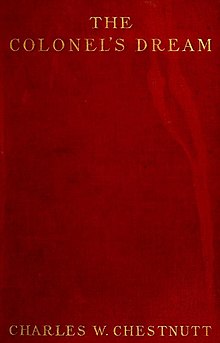
First edition cover of The Colonel's Dream (1905)
His concluding novel, The Colonel's Dream (1905), was described every bit "a tragic story of an idealist'due south endeavor to revive a depressed North Carolina boondocks through a socioeconomic plan much akin to the New South creed of Henry W. Grady and Booker T. Washington."[7] It featured a white aristocrat who returns to his boondocks during Reconstruction, when information technology is controlled by a lower-form white and is stagnating economically. Colonel Champion builds a new cotton wool mill, to attempt to establish business. He runs into conflicts because of racial bigotry and leaves the town in defeat.[12] The volume received picayune critical observe and sold hardly any copies. Chesnutt gave up thinking he could support his family by his writing.[seven] He built upward his court reporting business, lectured in the North, and became an activist with the NAACP.
Overall, Chesnutt'southward writing mode is formal and subtle. A typical sentence from his fiction is a passage from The House Backside the Cedars: "When the offset great shock of his discovery wore off, the fact of Rena'southward origin lost to Tryon some of its initial repugnance—indeed, the repugnance was non to the adult female at all, as their past relations were prove, but simply to the idea of her every bit a wife." - Chapter Twenty, "Digging upwards roots".
The Harlem Renaissance eclipsed much of Chesnutt'south remaining literary reputation. New writers regarded him every bit old-fashioned and pandering to racial stereotypes. They relegated Chesnutt to pocket-sized status.
Starting in the 1960s, when the Ceremonious Rights Movement brought renewed attention to African-American life and artists, a long procedure of critical give-and-take and re-evaluation has revived Chesnutt's reputation. In particular, critics have focused on the writer'due south complex narrative technique, subtlety, and utilise of irony. Several commentators have noted that Chesnutt broke new basis in American literature with his innovative explorations of racial identity, use of African-American speech communication and folklore, and the way in which he exposed the skewed logic of Jim Crow strictures. Chesnutt'southward longer works laid the foundation for the modern African-American novel.
Legacy and honors [edit]
- In 1913, Chesnutt was awarded an honorary LLD from Wilberforce University.[15]
- 1928, Chesnutt was awarded the NAACP's Spingarn Medal for his life's work.[16]
- In 1987, construction of the Charles Waddell Chesnutt Library was completed at the Fayetteville State Academy in Northward Carolina. (Chesnutt had been the second chief of the Howard School, afterwards known as Fayetteville State University.)
- Several of Chesnutt'due south works have been published posthumously, including essays. In 1989 William Fifty. Andrews wrote of him:
Today Chesnutt is recognized as a major innovator in the tradition of Afro American fiction, an important contributor to the deromanticizing trend in post-Civil War southern literature and a singular voice among plough-of-the-century realists who treated the colour line in American life.[7]
- In 2002, the Library of America added a major drove of Chesnutt's fiction and non-fiction to its important "American Authors" series, nether the title Stories, Novels And Essays: The Conjure Woman, The Wife of His Youth & Other Stories of the Color Line, The Firm Behind the Cedars, The Marrow of Tradition, Uncollected Stories, Selected Essays (Werner Sollors, ed.). His 2 major novels and some collected short stories are available online at the Academy of N Carolina, Wikisource. and other websites (run across beneath).
- On 31 Jan 2008, the United states of america Postal Service honored Chesnutt with the 31st postage in the Blackness Heritage Series.[14]
Race relations [edit]
Chesnutt's views on race relations put him between Du Bois' talented tenth and Booker Washington'due south dissever but equal positions. In a speech delivered in 1905 to the Boston Historical and Literary Association and later published equally an essay, titled "Race Prejudice; Its Causes and Its Cure," Chesnutt imagined a "stone by stone" dismantling of race animosity every bit the Black middle class grew and prospered. Filled with numbers and statistics, Chesnutt'south speech/essay chronicled Black achievements and Black poverty. He called for full civil and political rights for all African Americans.
He had little tolerance for the new credo of race pride. He envisioned instead a nation of "one people molded by the same culture." He ended his remarks with the following argument, made 58 years before Dr. Martin Luther King Jr. delivered his "I Take a Dream" speech communication:
Looking down the vista of time I see an epoch in our nation'due south history, not in my time or yours, but in the not distant future, when at that place shall be in the United States but one people, moulded by the same culture, swayed by the same patriotic ideals, holding their citizenship in such loftier esteem that for another to share it is of itself to entitle him to fraternal regard; when men will exist esteemed and honored for their character and talents. When manus in hand and center with heart all the people of this nation will join to preserve to all and to each of them for all hereafter time that ideal of human liberty which the fathers of the democracy set up out in the Declaration of Independence, which alleged that 'all men are created equal', the ideal for which [William Lloyd] Garrison and [Wendell] Phillips and [Sen. Charles] Sumner lived and worked; the platonic for which [Abraham] Lincoln died, the platonic embodied in the words of the Book [Bible] which the slave mother learned by stealth to read, with slow-moving finger and faltering spoken language, and which I fright that some of u.s.a. have forgotten to read at all-the Book which declares that "God is no respecter of persons, and that of 1 blood hath he made all the nations of the earth."
—"Race Prejudice; Its Causes and Its Cure" (1905)[17]
Selected written works [edit]
- The Conjure Woman (1899)
- The Wife of His Youth and Other Stories of the Color-Line (1899)
- "The Wife of His Youth"
- "The Passing of Grandison"
- Frederick Douglass (1899)
- The House Behind the Cedars (1900) novel
- The Marrow of Tradition (1901), novel
- The Colonel's Dream (1905), novel
Published posthumously [edit]
- A Concern Career (written in the 1890s; published 2005, University Press of Mississippi)
- Mandy Oxendine (written in the 1890s; published in 1997)
- Paul Marchand, F.1000.C. (written in 1921; published 1998, Academy Printing of Mississippi)
- Evelyn'southward Husband (2005, University Press of Mississippi)
- The Quarry (written 1928; published 1999, Princeton Academy Printing)
Collection [edit]
- Stories, Novels and Essays: The Conjure Adult female, The Wife of His Youth & Other Stories of the Color Line, The House Behind the Cedars, The Marrow of Tradition, Uncollected Stories, Selected Essays (Werner Sollors, ed., Library of America, 2002) ISBN 978-1-931082-06-8.
Adjusted in film [edit]
- In 1926, The Conjure Woman was adjusted by Oscar Micheaux into a film of the aforementioned proper name
- In 1927, The Business firm Backside the Cedars was adjusted by Oscar Micheaux into a film of the same name
- In 2008, Dante James, a pupil at Duke Academy, fabricated a film adapted from Chesnutt'south short story The Doll.[18] This story was first published in The Crisis in 1912.[xix] [20] It was for a course entitled "Adapting Literature, Producing Picture".[21] The pic premiered at the San Diego Blackness Flick Festival on January 31, 2008, where Clayton LeBouef won an accolade for "Best Histrion".[22] [23] Information technology also won "All-time Short Film" at The Sugariness Auburn International Film Festival, and the "Short Pic" award at the Hollywood Black Film Festival.
See as well [edit]
- African American literature
- The Conjure Woman (film version past Oscar Micheaux)
- The House Behind the Cedars (pic version by Oscar Micheaux)
Notes [edit]
- ^ The ane-drop rule was office of Virginia'southward Racial Integrity Act in 1924.
References [edit]
- ^ a b c d e Sutton, John 50. (2001). Philip A. Greasley (ed.). Dictionary of Midwestern Literature: The Authors. Indiana Academy Printing. pp. 108–110. ISBN978-0-253-33609-five . Retrieved April eighteen, 2013.
- ^ Andrews, William L. (March i, 1999). The Literary Career of Charles West. Chesnutt. LSU Printing. p. 139. ISBN9780807124529 . Retrieved April 11, 2020.
- ^ "Schools and Education During Reconstruction". American Feel. PBS. Retrieved June 24, 2020.
- ^ Williams, Heather Andrea (2005). Cocky-taught: African American didactics in slavery and freedom. Chapel Loma: Academy of Due north Carolina Press. p. 97. ISBN080782920X.
- ^ Ronnick, Michele Valerie. "Within CAMWS Territory: Helen Chiliad. Chesnutt (1880-1969), Black Latinist". Wayne Country University. Retrieved January 22, 2018.
- ^ "A Familial Perspective of Charles Chesnutt". Archived from the original on 13 June 2011. Retrieved January 22, 2018.
- ^ a b c d e f yard h Wiliam L. Andrews (1989). "Charles Waddell Chesnutt". In Charles Reagan Wilson; William Ferris (eds.). Encyclopedia of Southern Culture. University of Northward Carolina Press.
- ^ Richard H. Pildes, "Democracy, Anti-Democracy, and the Canon", Constitutional Commentary, Vol. 17, 2000. Retrieved March 10, 2008.
- ^ Jae H. Roe, "Keeping an "old wound" live: 'The Marrow of Tradition' and the legacy of Wilmington", African American Review, Summertime 1999. Retrieved March xiii, 2011.
- ^ Chesnutt, Helen Yard. (1952). Charles Waddell Chesnutt: Pioneer of the Colour Line. Chapel Hill: University of Due north Carolina Press. p. 213.
- ^ "Chestnutt Rites Held". The Plain Dealer. November xix, 1932. p. thirteen.
- ^ a b c d east Gloster, Hugh One thousand. (1941). "Charles Due west. Chesnutt, Pioneer in the Fiction of Negro Life". Phylon. 2 (ane): 57–66. doi:10.2307/271454. JSTOR 271454. Retrieved December 8, 2013.
- ^ a b c William Dean Howells, "Mr. Charles W. Chesnutt's Stories", Atlantic Monthly, May 1900. Retrieved December 8, 2013.
- ^ a b Lucy Moore, "Crossing the Colour Line", The Atlantic Monthly, 31 Jan 2008. Retrieved Dec 8, 2013.
- ^ Sherman, Joan R., ed. (1995). Tales of Conjure and the Color Line, 10 Stories past Charles Waddell Chestnutt. New York. pp. 3–6.
- ^ "NAACP Spingarn Medal Winners". NAACP. Archived from the original on November ane, 2017. Retrieved March 11, 2018.
- ^ Charles W. Chesnutt, "Race Prejudice; Its Causes and Its Cure" Archived February ten, 2012, at the Wayback Machine, Stephanie P. Browner (ed.), The Charles Chesnutt Digital Archive Website, Berea College. Retrieved March 13, 2011.
- ^ "Dante James", Film/Video/Digital, Duke Academy .
- ^ The Crisis, 3 (April 1912) pp. 248–52; reprinted in Brusk Fiction, 1974, pp. 405–12. Also published in Tales of Conjure and the Color Line: x Stories, 1998, pp. 109–17.
- ^ Williams, Kam. "Dante James: 'The Doll' Interview". Insight News. Archived from the original on February 13, 2008. .
- ^ "'The Doll' from Story to Screen". Adapting Literature, Producing Film. Duke University. Archived from the original on Oct 18, 2012. Retrieved January 31, 2008. .
- ^ "Films". San Diego Black Film Festival. 2008. Retrieved January 25, 2008. [ permanent expressionless link ] .
- ^ "The Doll Selected for Picture Festivals". DMD Films. Archived from the original on July 6, 2008. Retrieved June fifteen, 2008. .
Further reading [edit]
- Andrews, William. The Literary Career of Charles Westward. Chesnutt, Baton Rouge: Louisiana Country Upward, 1980. Print.
- Chesnutt, Helen M. (1952). Charles Waddell Chesnutt: Pioneer of the Colour Line. Chapel Hill: University of North Carolina Press. ISBN9780807806210. LCCN 52010239. Retrieved Jan 17, 2014.
- Keller, Frances Richardson (1978). An American Crusade: The Life of Charles Waddell Chesnutt . Provo, Utah: Brigham Immature University Press. ISBN0842508376. LCCN 77014608.
- "Charles Chesnutt biography". Library of America website. Archived from the original on January 25, 2008.
- Scott McLemee (March i, 2002). "The Anger and the Irony". Chronicle of Higher Didactics.
- Gates, Henry Louis Jr.; McKay, Nellie Y., eds. (2004). "Charles Waddell Chesnutt". The Norton Anthology of African American Literature (second ed.). New York: Norton.
- "Charles Waddell Chesnutt". Literary Classics of the The states. Archived from the original on March nine, 2012.
- "The Charles Chesnutt Digital Archive". Accomplish created, edited, and maintained past Stephanie P. Browner (Berea College). Archived from the original on March 14, 2012.
- Chesnutt, Charles W. (1991). Tibbetts, Robert A. (ed.). Who and Why was Samuel Johnson. Akron, Ohio: Northern Ohio Bibliophilic Gild.
- Richardson, Mark. "Charles Chesnutt: Nowhere to Turn." In The Wings of Atalanta: Essays Written Forth the Color Line (pages 164–204). Rochester, New York: Camden House, 2019. ISBN 9781571132390
External links [edit]
- Works by Charles W. Chesnutt in eBook form at Standard Ebooks
- Works by Charles W. Chesnutt at Projection Gutenberg
- Works past or about Charles W. Chesnutt at Internet Annal
- Works by Charles W. Chesnutt at LibriVox (public domain audiobooks)

- "Charles W. Chesnutt", Library of America
- Charles Due west. Chesnutt, The Marrow of Tradition, total etext at Wikisource
- Charles W. Chesnutt, The House Behind the Cedars, full etext at Wikisource
- The Charles Due west. Chesnutt Digital Annal, Sarah Browners, Berea College in cooperation with Fisk Academy Library
- Chesnutt Literary Web, Rutgers University
- Frederick Douglass, (biography by Charles Chesnutt) Boston: Modest, Maynard, 1899, hosted on Documents of the American South, Academy of North Carolina
- Chesnutt's "Sis Becky'due south Pickaninny" Archived 2013-06-15 at the Wayback Motorcar, dramatization on VHS
- The Charles Chesnutt Digital Annal
- Charles W. Chesnutt stamp
- Charles Waddell Chesnutt, Find a Grave
- Drove of Photographs relating to Charles W. Chesnutt at Cleveland Public Library

Charles Chesnutt The Goophered Grapevine,
Source: https://en.wikipedia.org/wiki/Charles_W._Chesnutt
Posted by: adamsrequithe.blogspot.com
0 Response to "Charles Chesnutt The Goophered Grapevine"
Post a Comment